
May 1, 2026 | 8pm (doors 7:30pm) | at The Georgetown Steam Plant | 6605 13th Ave S, Seattle, WA 98108
Anthony McCall: Line Describing a Cone + Conical Solid
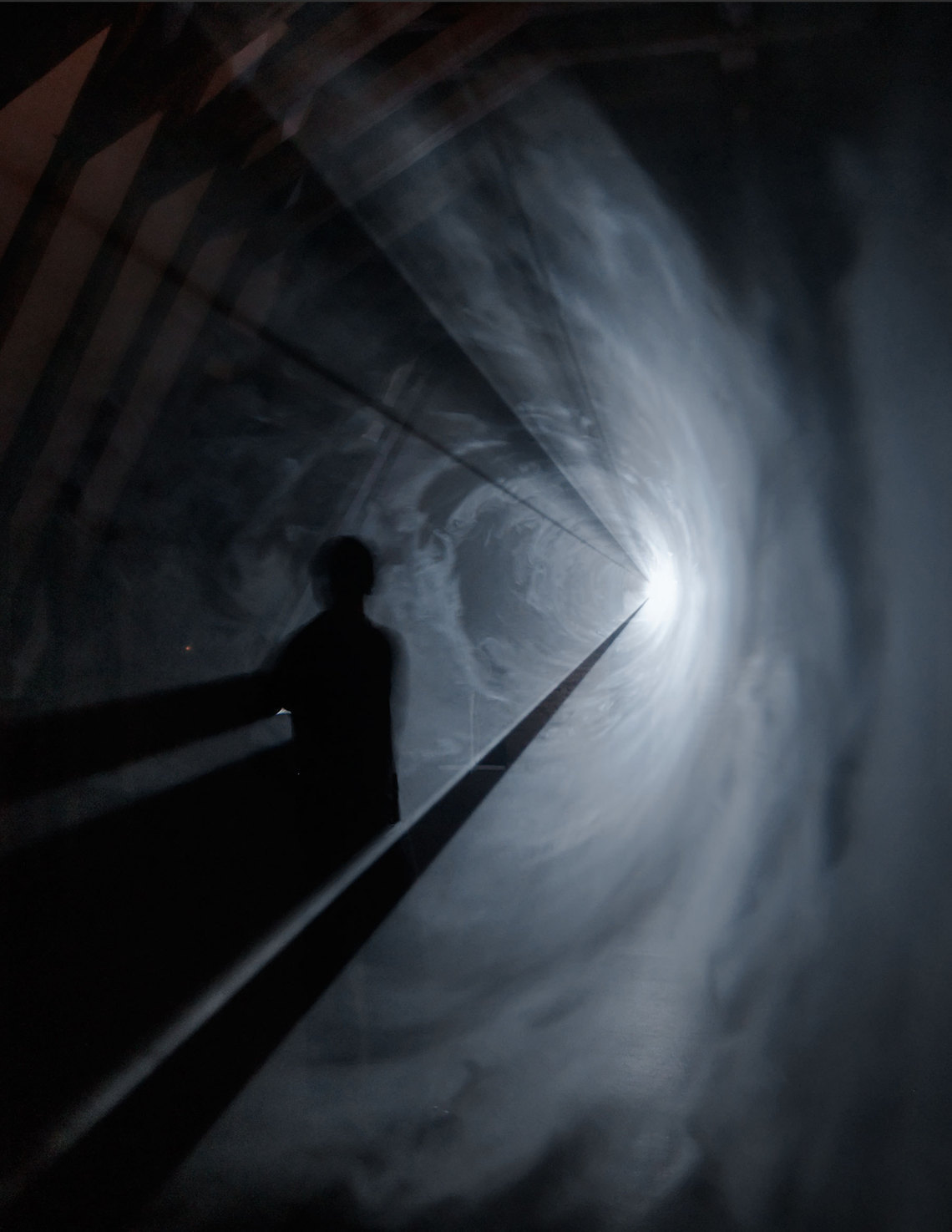
Two historical works of “expanded cinema”, both from 1973 by British artist Anthony McCall, in a rare presentation at the Georgetown Steam Plant. Line Describing a Cone (30 min) and Conical Solid (10 min) are what McCall describes as “solid light films”; made for 16mm film projection and illuminated by fog. Both of these works create sculptural forms of light which take shape through time.
Co-presented with Mount Analogue • Art + Cinema.
Please note: access to the presentation at the Georgetown Steam Plant requires ascending a flight of stairs. The temperature inside may be cool, dress appropriately.
Line Describing a Cone
(1973, UK, 30 min, 16mm) Anthony McCall
Line Describing a Cone is what I term a solid light film. It deals with the projected light beam itself, rather than treating the light beam as a mere carrier of coded information, which is decoded when it strikes a flat surface.
The viewer watches the film by standing with his or her back toward what would normally be the screen, and looking along the beam toward the projector itself. The film begins as a coherent pencil of light, like a laser beam, and develops through thirty minutes into a complete, hollow cone.
Line Describing a Cone deals with one of the irreducible, necessary conditions of film: projected light. It deals with this phenomenon directly, independently of any other consideration. It is the first film to exist in real, three-dimensional space.
This film exists only in the present: the moment of projection. It refers to nothing beyond this real time. It contains no illusion. It is a primary experience, not secondary. – A.M.
Conical Solid
(1973, UK, 10 min, 16mm) Anthony McCall
Extracts from ‘Notes in Duration’:
“A static thing, in terms of impulses to the brain, is a repetitive event. Whether the locus for consideration is ‘static’ or ‘moving’, we deal with time-spans of attention, the engagement of cognition and memory within the context of art-behaviour. Neither objects nor events are for the most part accessible. They are rarely ‘on show’. Since they are intentional, meaningful signs, this is of no consequence: once an idea is established ‘in mind’, it has entered the circuit of (art) ideas, and it won’t go away, except through debate within that circuit.” – A.M. (from the catalogue to Festival of Expanded Cinema, 1976).
Elements: Material and Process in the Moving Image is a six-part film series, presenting twenty-five works from contemporary artists, and conceived in dialogue with the exhibition HAUNTED.
Curated by David Dinnell and Jay Kuehner
Focusing on matter that spans both natural and artificial realms – and its transformation through manual, mechanical, and organic processes – the works in this series undertake an accounting of the lived world. Taken in context with the TAM exhibition HAUNTED, these selected works collectively consider how the experiential is framed through empirical and intuitive means, with moving images acting as witness, catalyst, surrogate, and archive. Manifest in extractive and generative forms, destructive and productive acts, durable to ephemeral ends, the processual – as cinematic event – reveals latent histories in granular form but of ever-increasing consequence. Featuring 25 works that scale from deeply personal to broadly historical, from geologic to anthropogenic; fusing the merely observational to the sheerly operational image.