
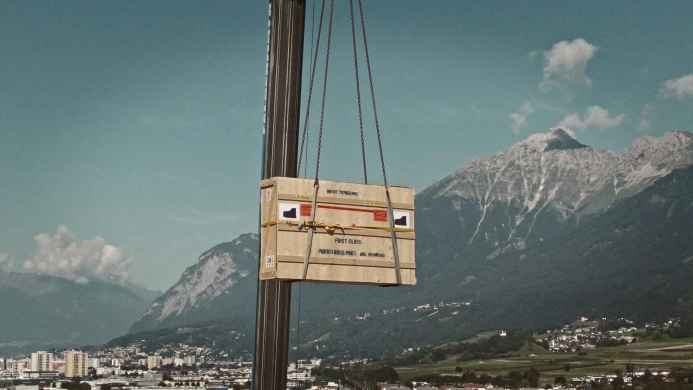
In this program, titled “The Way Things Go,” the notion of the ‘object lesson’ is stripped of metaphor and returned to its original context as sensory observation (cultivated by British educator Elizabeth Mayo in the 19th Century in her texts Lessons on Objects and Lessons on Shells). The properties of objects and matter, along with their transformations through use value, are witnessed with exacting, revelatory attention.
An arduous fishing technique, involving hand framed nets held steady by fisherfolk of the Solway estuary between England and Scotland (and dating back over a thousand years to the Viking Age), is brought to vivid life by its extant practitioners in Julie Parks’ and Heather Andrews’ Haaf (2020). In The Mesh and the Circle (2014), by Portuguese directing duo Mariana Caló and Francisco Queimadela, a pensive and playful interrogation occurs: can empirical knowledge of the object world be sponsored by the otherwise spectral nature of the moving image? Through a series of quotidian activities, patterns and relations emerge between forms of magic, pleasure, geometry, symbolism and labor. Sasha Pirker’s study of a lone Steinway grand piano (the tuner, 2023) subtly shifts from an inventory of its intricate making to that of its daunting maintenance under the fastidious care of a master tuner, his work seemingly never finished. The liminal space between body and machine is explored to acute visceral effect in Yuri Ancarani’s depiction of a robotic surgery administered by a human surgeon in Da Vinci (2012). The titular, sci-fi like ‘cold valley’ of Florian Fischer & Johannes Krell’s Kaltes Tal (2016) appears blanketed in a layer of fresh snow but is revealed, through patient observation of a mining operation, the be liming (an application to neutralize soil acidity in the forest through calcium and magnesium rich material). Landforms (2024), by Laura Kraning, examines the geological strata where ancient fossils and consumer waste (in the form of microplastics) each reveal particularities of inhabitation – from once sea creatures to current land mammals – inscribed in the landscape.
Haaf (2020, United Kingdom, 12 min, 16mm to digital file) Julie Parks, Heather Andrews
On the shifting waters of the Solway Firth, the last Haaf netters keep alive an ancient fishing tradition—captured in images hand-developed with seaweed gathered from the same shores.
The Mesh and the Circle ( 2014, Portugal, 34 min., digital file) Mariana Caló and Francisco Queimadela
Over the course of several months, Mariana Caló and Francisco Queimadela collected visual testimonies of various labor and ludic activities and other daily practices rooted in empirical knowledge. Establishing intuitive relations between concrete gestures and substances, sensorial experiences and analogical thinking, the authors have created a fragmentary film immersed on the idea of transformation of matter, generating a revolving movement that metamorphoses itself over time. Throughout a sequence of diverse quotidian activities, solutions and abilities the spectator is conducted over a series of connections in a game of interplay between forms of magic, pleasure, geometry, symbolism and labor.
the tuner (2023, Austria, 13 min, digital file) Sasha Pirker
Shrouded and strangely out of place, a Steinway grand piano stands in the middle of a sparse office ambience. The unpacking is followed by the first inspection: “I think it has all the prerequisites,” says the expert – who is perhaps the best in his profession – and gets to work. From this point onward, piece by piece, he will uncover, clean and measure the inner workings of the piano. Hammers strike strings, and mutes, keys, and tuning pegs are devotedly optimized, tightened, taken apart and put back together with millimeter precision. Every move is perfect, while every unnecessary disturbance seems to be absorbed in the vacuum of this remote “White Cube”. In this way, the piano tuner’s listening becomes visible and his professional mastery can be experienced: calm, concentrated and almost meditative.
Da Vinci (2012, Italy, 25 min, 35mm to digital file) Yuri Ancarani
Robotic surgery department. A surgeon performs an entire operation, controlling the robot’s motions using a joystick.
Kaltes Tal (Cold Valley) (2016, Germany, 12 min, digital file) Florian Fischer & Johannes Krell
Oscillating between aesthetic and documentary forms, the short film Cold Valley (Kaltes Tal) describes the daily business of a strip mine harvesting lime. The material removed is processed and returned to nature through forest liming. This measure attempts to counteract acid rain that troubles the forest floor. A cycle like a Mobius strip – an irreversible consequence due to the mining materials in order to restore the fragile natural balance. Lime dust delicately dusts the forest floor. A white, spherical alternative world opens, questioning our ambivalent relationship to nature.
Landforms (2024, US, 12 min, digital file) Laura Kraning
Landforms unearths the physical remains of past and future geological strata. The film explores two landscapes, an industrial rock quarry turned recreational fossil hunting park, in which 380-million-year-old fossils were discovered beneath the rocks where once flowed a shallow sea, and a public waterway whose shore is dispersed with brightly colored fragments of consumer waste in the form of microplastics. Both landscapes reveal a process of digging and gathering, of collecting evidence of earth’s pre-historic past, or intervening in humanity’s toxic futures. The forms – of ancient sea creatures and broken plastic – mesh and intertwine into a meditation on deep time and a reflection on extinction.
Elements: Material and Process in the Moving Image is a six-part film series, presenting twenty-five works from contemporary artists, and conceived in dialogue with the exhibition HAUNTED.
Curated by David Dinnell and Jay Kuehner
Focusing on matter that spans both natural and artificial realms – and its transformation through manual, mechanical, and organic processes – the works in this series undertake an accounting of the lived world. Taken in context with the TAM exhibition HAUNTED, these selected works collectively consider how the experiential is framed through empirical and intuitive means, with moving images acting as witness, catalyst, surrogate, and archive.
Manifest in extractive and generative forms, destructive and productive acts, durable to ephemeral ends, the processual – as cinematic event – reveals latent histories in granular form but of ever-increasing consequence. Featuring 25 works that scale from deeply personal to broadly historical, from geologic to anthropogenic; fusing the merely observational to the sheerly operational image.